

Theft Charges in Thailand: Why the Value of the Item Is Not the Whole Case
Theft Charges in Thailand: Why the Value of the Item Is Not the Whole Case
A watch, telephone, suitcase, or other item of modest value can still lead to an arrest, bail proceedings, travel disruption, and a criminal case carrying a potential prison sentence in Thailand.
That does not mean every accidental taking is theft. Thai criminal law requires more than the mere possession of property belonging to another person. The prosecution must establish that the property was taken intentionally and dishonestly.
The real issue is therefore rarely limited to the price of the item.
What usually matters more is why the property was taken, what the accused did afterwards, what the available evidence shows, and whether the circumstances make the allegation a more serious form of theft.
For foreign nationals, these questions can become particularly urgent. An incident that initially appears to be a simple misunderstanding may lead to a police investigation, an arrest warrant, restrictions on travel, an application for bail, and criminal proceedings in a province far from where the accused normally lives.
In a Thai theft case, the price of the property may influence the practical assessment of the case, but it does not determine whether theft occurred or which statutory penalty applies.
The Essential Points
Under Thai law:
What Constitutes Theft Under Thai Law?
Section 334 of the Thai Penal Code covers the basic offence of theft. It applies when a person dishonestly takes property belonging to another person, including property that is jointly owned by another person.
Ordinary theft is punishable by imprisonment for up to three years, a fine of up to THB 60,000, or both.
The word dishonestly is important. Under Section 1 of the Penal Code, dishonest conduct involves seeking a benefit for oneself or another person to which there is no lawful entitlement. Section 59 also establishes the general principle that criminal liability ordinarily requires intentional conduct.
This means that accidentally picking up the wrong item does not, by itself, establish theft.
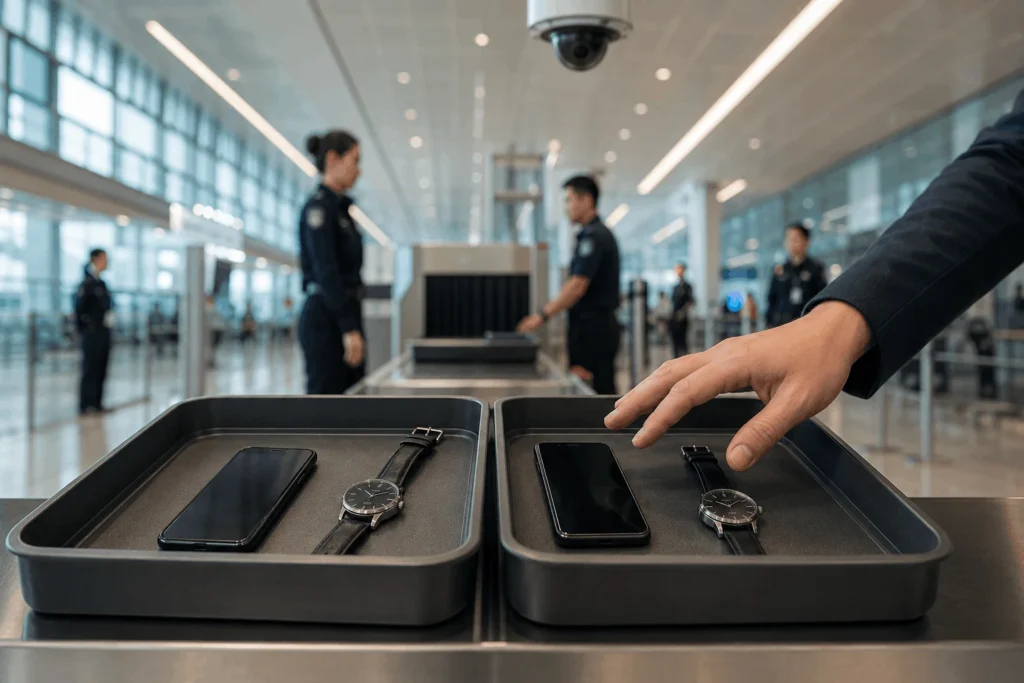
A person may collect the wrong suitcase from a baggage carousel, place another passenger’s telephone in their bag after an airport security check, or leave a restaurant with a similar-looking umbrella. These situations may involve possession of someone else’s property, but possession alone is not sufficient.
The central question is whether the person intended to take the property dishonestly.
When Is Taking the Wrong Property an Honest Mistake?
Mistakes are entirely possible in busy public environments.
At airport security checkpoints, passengers may place watches, telephones, laptops, wallets, belts, passports, bags, and other belongings into several trays. At baggage reclaim, multiple suitcases may have the same colour, size, and brand. Similar confusion can occur in hotels, restaurants, shops, taxis, buses, and other public facilities.
The legal difficulty is not whether such a mistake is theoretically possible. It is whether the evidence supports the explanation in the particular case.
A prompt and voluntary response may help demonstrate an absence of dishonest intention. Relevant conduct may include:
However, returning the property does not automatically prove that the original taking was accidental.
Investigators will normally examine the complete sequence of events: how the item was taken, where it was placed, whether it was concealed, how long it was retained, when the accused realized the mistake, and whether the return occurred voluntarily or only after the accused had been identified.
A genuine mistake is a possible defence. Its strength depends on the evidence, not merely on the accused describing the incident as an accident.
How Do Thai Police and Courts Assess Criminal Intention?
Direct evidence of intention is unusual. People rarely admit that they intended to steal.
Intention is therefore commonly inferred from conduct, surrounding circumstances, witness accounts, and documentary or digital evidence.
Evidence in a theft investigation may include:
CCTV footage can be particularly significant.
For example, taking a common black suitcase from a crowded baggage carousel may support a plausible explanation of confusion. The position may be different if footage shows a person leaving the carousel allocated to their flight, entering another baggage area, selecting a distinctive suitcase, removing its identification tag, and leaving the airport.
The same distinction can apply to smaller objects. A passenger who finds an unfamiliar watch among their belongings and immediately reports it presents a different evidential picture from someone who places it in a pocket, leaves the premises, and retains it until contacted by police.
No single fact necessarily decides the case. The evidence must be considered as a whole.
Why the Location of the Alleged Theft Matters
Not every theft allegation carries the same statutory penalty.
Section 335 of the Thai Penal Code identifies circumstances in which theft is treated more seriously. These include theft committed:
The current Thai wording of Section 335 expressly includes railway stations, airports, public parking facilities, public vessel-mooring facilities, cargo-transfer locations, and public conveyances.
Where one qualifying circumstance applies, the statutory punishment is generally:
Imprisonment from one to five years and a fine from THB 20,000 to THB 100,000.
Where two or more qualifying circumstances apply, the punishment generally increases to:
Imprisonment from one to seven years and a fine from THB 20,000 to THB 140,000.
This is not simply a mathematical increase based on the value of the property. The law places the conduct within a different statutory category because of where, when, or how the alleged theft occurred.
This is not simply a mathematical increase based on the value of the property. The law places the conduct within a different statutory category because of where, when, or how the alleged theft occurred.
If the incident also occurred at night or involved more than one person, multiple aggravating circumstances may need to be considered.

Why Airports and Transportation Facilities Receive Additional Protection
Airports, railway stations, public transportation, ports, and cargo facilities are environments in which large numbers of people and substantial volumes of property pass through controlled spaces.
Passengers are frequently:
The law’s treatment of these locations reflects the broader risks associated with theft in public transportation environments.
This does not remove the prosecution’s obligation to prove dishonest intention. Location alone does not convert an honest mistake into theft.
Location becomes important once the required elements of theft have been established.
Can Returning the Property End the Case?
Returning the property can be highly relevant, but it does not necessarily terminate the criminal proceedings.
A voluntary return may support an argument that the taking was accidental. Compensation, an apology, or other remedial conduct may also influence:
However, ordinary and aggravated theft are generally treated as non-compoundable offences. This means the matter is not automatically extinguished simply because the owner accepts compensation, receives the property back, or no longer wishes to pursue the complaint.
The financial loss and the criminal allegation are separate legal issues.
Paying the value of the property may address the owner’s economic loss. It does not retrospectively decide whether the property was originally taken dishonestly.
The police, public prosecutor, and court may therefore continue with the case despite an agreement between the accused and the owner.
Protect your property investment in Thailand. Closer Law reviews foreign ownership structures, nominee risks, land agreements, leases, usufruct, superficies, rental use, license issues, tax exposure, and villa management arrangements.
The Criminal Process May Become the Greater Consequence
For a foreign defendant, the procedural consequences can rapidly become more serious than the value of the property involved.
Depending on the circumstances, the case may involve:
Thai criminal courts may have jurisdiction where the offence was committed, alleged or believed to have been committed, where the accused resides or was arrested, or where the inquiry official conducts the investigation.
This can create a serious logistical problem.
A person arrested in Bangkok may discover that the underlying complaint was filed in Phuket, Chiang Mai, Chonburi, Surat Thani, or another province. Local representation and coordination with the relevant police station, prosecutor, and court may then be required.
An allegation concerning an inexpensive item can consequently interfere with an international flight, employment, accommodation, family obligations, and immigration status.
These consequences do not establish guilt. They are procedural consequences that may arise while the allegation is being investigated and adjudicated.
Legal source note: Thai Civil and Commercial Code provisions recognize usufruct rights over immovable property, including rights of possession, use, and enjoyment, subject to legal conditions.
What Should a Foreign National Do After Being Accused?
The first steps taken after an accusation can materially affect the defence.
1. Do not speculate
Avoid giving several different explanations to police officers, security personnel, the owner, traveling companions, or other third parties before the facts are clear.
Minor inconsistencies can later be used to challenge credibility.
2. Preserve all relevant evidence
Do not delete messages, photographs, location data, receipts, boarding passes, hotel confirmations, or other information that may establish the chronology.
3. Request preservation of CCTV footage
CCTV footage may not be retained indefinitely. The location should be identified and a preservation request considered without unnecessary delay.
4. Establish who owns each relevant item
Receipts, photographs, serial numbers, baggage tags, warranties, and earlier messages may help show which property belonged to the accused.
5. Identify the exact charge
The legal assessment depends on whether the allegation concerns ordinary theft, aggravated theft, misappropriation, receiving stolen property, or another offense.
These offenses have different legal elements and procedural consequences.
6. Obtain Thai criminal counsel
Foreign lawyers may assist with documents and communication in the client’s home country, but representation and advice concerning the Thai investigation, bail process, prosecution, and court proceedings should be handled by qualified Thai counsel.
7. Contact the relevant embassy or consulate where appropriate
Consular officials may assist with welfare matters, contact with family, lists of lawyers, and certain administrative issues.
They cannot direct the police, prosecutor, or court, and they do not replace criminal defence counsel.
What Should Families Overseas Do?
Families often receive incomplete or emotionally charged information after an arrest.
The immediate priority should be to establish:
Families should be cautious about constructing a defence narrative before obtaining the police allegations and available evidence.
A well-intentioned explanation developed through incomplete telephone calls may conflict with CCTV footage, witness statements, or an earlier account. It is normally better to secure the documents, establish the chronology, and obtain local legal advice before making detailed representations.
Frequently Asked Questions
Families should be cautious about constructing a defence narrative before obtaining the police allegations and available evidence.
Final Thoughts
The value of the property is only one part of a theft case in Thailand.
The more important questions are:
A low-value item does not automatically mean a low-risk case. Equally, temporary possession of another person’s property does not automatically prove theft.
The outcome depends on the legal elements of the offence and the evidence available to prove—or challenge—those elements.
When intention is disputed, the defence should begin with the evidence, not with assumptions about the value of the item.
Accused of Theft in Thailand?
Closer Law advises and represents foreign nationals facing criminal investigations and court proceedings in Thailand.
Our criminal defense team can assist with:
Early legal intervention can be important, particularly where CCTV footage, travel records, or other evidence may only be available for a limited period.
Contact Closer Law for a confidential initial assessment of your case.
Legal Disclaimer
This article provides general information concerning Thai criminal law and procedure. It does not constitute legal advice and should not be relied upon as a substitute for advice based on the specific facts of a case. Criminal charges, bail conditions, available defenses, prosecutorial decisions, and sentencing outcomes depend on the evidence and circumstances of each matter. English translations of Thai legislation are provided for reference; the official Thai-language legislation prevails.